So if you follow this blog, you must think I died or quit gardening. Quite the contrary. While the rest of the country has been dreaming of gardening, I've been doing it.
The South Florida growing season is drawing to a close and the rest of you are just getting started, Here is what worked for me this year and what was a flop!
The Biggest Loser!

By far, the worst performers in my garden this season were the cucurbits! I am not holding a pity party for them however. They had much going against them, but they didn't give it much of a try. I know I was not alone. During a visit to a local nursery in January I overheard the staff in charge of the vegetable section tell a customer they had no luck with cucurbits either. Our November was cooler than normal, followed by a December that was not only cool, but it was damp as well. A quick review of cucurbit growing conditions does not include the terms "damp" or "cool". I managed to get just a few Straight Eight cukes out of a raft using the Deep Water Culture (DWC) technique. Growing a vining plant using DWC is always a challenge. We ran string to get it to the garden frame and then just let it grow from there. The plants in the flood and drain grow beds never produced at all. I ripped them out in January. Despite many different attempts, I was not able to get new seeds to sprout. Zero squash, zero melons, few cucumbers. Cucurbits were a bust!
The Loser Runner Up!
Is there a runner up loser place at the podium? I don't know if it is official place, but cucurbits were almost beat out by the nightshades as poor performers. The cool and damp conditions were not embraced by the eggplants. They were tolerated by the peppers and the tomatoes thrived so the nightshades mixed performance kept them out of the bottom position.

The irregular weather conditions resulted in problems with chlorosis. I had to chelate more this season than I have in any season past. This picture is a perfect representation of the eggplant problem this season. I harvested less than a dozen fruits. Usually I can keep eggplant going into May. This year it was done by February. This is the second year I have grown eggplants relying solely on aquaponic methods. Last year was such a success! This year not so much. Next growing season, I commit to growing with and without soil.
The Good Stuff
Now for the winners! I tried celery in a flood and drain bed for the first time. OK, true confession time, it is the first time I have tried to grow celery ever. Maybe celery is easy to grow, maybe the cooler than normal temperatures were a factor. I just know that it grew exceptionally well. It has been tasty too!
So next year I will try celery again and see if it is a fluke. As an aside, I discovered that celery leaves are pretty tasty when they are young but bitter when they are older. It is awesome to harvest your celery and then not spend all that time in the kitchen scrubbing the dirt off. That is an unsung benefit of growing with aquaponics, faster produce cleaning in the kitchen!
Another big winner were the greens. I grew kale and swiss chard with
lots of success. The chards took a littler longer to get going this
year, but once they got going, there was no holding them back. The chards and kale were grown in both NFT tubes and flood and drain beds. I didn't try any of these in soil this season.
Last year, the greens in the NFT tubes were the big winners, this year the plants in the flood and drain beds out performed their tube counterparts. It just goes to show that when it comes to gardening, there are always surprises.
This was my first season with Dinosaur kale. It grows very quickly no
matter the weather or light conditions. Three plants were all that were
necessary to provide more than enough for our table of 2.
The Winners!
The winners were the mints, including basil and the peppers and the tomatoes. I had tomatoes in soil and tomatoes in my aquaponic gardens. I tried something old, Mr. Stripey, something new, Arkansas Traveler, and something borrowed and blue, Indigo Rose!
The basil went wild in the NFT tubes. I had to end up moving a Dinosaur kale to make more room.
This is an Indigo Rose growing in an NFT Tube with a little cayenne pepper poking out behind it. The Indigo Rose seeds were from my son's garden in Ohio. When I visited in August, I opened one of his ripe tomatoes onto a paper towel and spread out the seeds and flesh to dry. I brought the dried paper towel home and planted it, towel and all in October. The Indigo Rose was by far the most prolific producer. I had them in DWC rafts, flood and drain beds and soil. They performed well in all situations. The only down side to this tomato is that it takes for-fricking-ever to ripen. The portion of the tomato that is kissed by the sun turns a bluish purple, the remainder will turn red or yellow when the tomato is ripe.

This was my Arkansas Traveler when it was setting its first fruit. I only had one plant this year, but will certainly save seeds (using the paper towel method) because this is a great tasting tomato. It doesn't grow extremely large in either plant size or fruit size. When ripe, it is a pink color. It is very tasty and low acid.
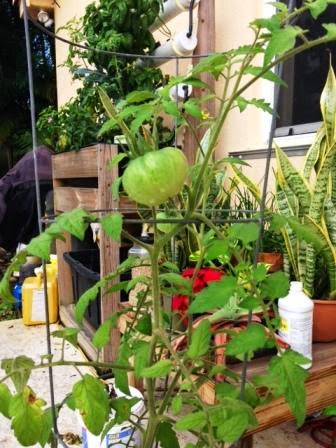
This is a "Mr. Stripey" that was growing in soil in a pot. A real down side to buying starter plants is that anyone with a sense of mischief can cause problem in the garden center. I bought this plant as a start and it was clearly marked "Mr. Stripey", which happens to be one of my favorite tomato varieties. As it began to set fruit, O started doubting the veracity of the tag. The tomatoes weren't as large as they should be and didn't exhibit stark striping. When the first fruits started to ripen I knew I had been had. The fruits turned red and not the beautiful orange-ish shade sported by Mr. Stripey. I don't know who this imposter is, but it produces a medium sized red tomato with very light striping. Unlike Mr. Stripey, it is very low acid. I am not saving the seeds. I considered prosecuting it for impersonating a beloved heirloom, but decided the real culprit was the person at the garden center, not the plant.
Inedibles in Closing
Believe it or not, the winter months aren't all about vegetables here at the end of the peninsula. The shorter days mean that lots of plants start to bloom. While you are looking at snow, I'm looking at kolanchoes.
I'm enjoying the orchid blossoms.
And the Bolivian gloxinias start to bloom before Christmas and take us all the way through to Easter.
My season was a mixture of hits and misses. Let me know what you are doing to make your season a success. I'd love to hear from you!


 Cooler nights brings on the blooms in many orchids. Kalanchoes are also
reliable winter bloomers in the South Florida garden.
Cooler nights brings on the blooms in many orchids. Kalanchoes are also
reliable winter bloomers in the South Florida garden. 


