Showing posts with label aquaponic gardens. Show all posts

Tuesday, April 21, 2015

South Florida Gardening Winners and Losers

So if you follow this blog, you must think I died or quit gardening.  Quite the contrary.  While the rest of the country has been dreaming of gardening, I've been doing it.

The South Florida growing season is drawing to a close and the rest of you are just getting started,  Here is what worked for me this year and what was a flop!

The Biggest Loser!

cucumber growing with aquaponicsBy far, the worst performers in my garden this season were the cucurbits!  I am not holding a pity party for them however.  They had much going against them, but they didn't give it much of a try.  I know I was not alone.  During a visit to a local nursery in January I overheard the staff in charge of the vegetable section tell a customer they had no luck with cucurbits either.  Our November was cooler than normal, followed by a December that was not only cool, but it was damp as well.  A quick review of cucurbit growing conditions does not include the terms "damp" or "cool".  I managed to get just a few Straight Eight cukes out of a raft using the Deep Water Culture (DWC) technique.  Growing a vining plant using DWC is always a challenge.  We ran string to get it to the garden frame and then just let it grow from there.  The plants in the flood and drain grow beds never produced at all. I ripped them out in January.  Despite many different attempts, I was not able to get new seeds to sprout.  Zero squash, zero melons, few cucumbers.  Cucurbits were a bust!

The Loser Runner Up!

Is there a runner up loser place at the podium?  I don't know if it is official place, but cucurbits were almost beat out by the nightshades as poor performers.  The cool and damp conditions were not embraced by the eggplants.  They were tolerated by the peppers and the tomatoes thrived so the nightshades mixed performance kept them out of the bottom position.  eggplant in aquaponics The irregular weather conditions resulted in problems with chlorosis.  I had to chelate more this season than I have in any season past.  This picture is a perfect representation of the eggplant problem this season.  I harvested less than a dozen fruits.  Usually I can keep eggplant going into May.  This year it was done by February. This is the second year I have grown eggplants relying solely on aquaponic methods. Last year was such a success!  This year not so much.  Next growing season, I commit to growing with and without soil. 

The Good Stuff

Now for the winners!  I tried celery in a flood and drain bed for the first time.  OK, true confession time, it is the first time I have tried to grow celery ever.  Maybe celery is easy to grow, maybe the cooler than normal temperatures were a factor.  I just know that it grew exceptionally well. It has been tasty too!
celery in aquaponics
So next year I will try celery again and see if it is a fluke.  As an aside, I discovered that celery leaves are pretty tasty when they are young but bitter when they are older.  It is awesome to harvest your celery and then not spend all that time in the kitchen scrubbing the dirt off.  That is an unsung benefit of growing with aquaponics, faster produce cleaning in the kitchen!


swiss chard in aquaponics
Another big winner were the greens.  I grew kale and swiss chard with lots of success.  The chards took a littler longer to get going this year, but once they got going, there was no holding them back. The chards and kale were grown in both NFT tubes and flood and drain beds.  I didn't try any of these in soil this season.


Last year, the greens in the NFT tubes were the big winners, this year the plants in the flood and drain beds out performed their tube counterparts.  It just goes to show that when it comes to gardening, there are always surprises. 

This was my first season with Dinosaur kale.  It grows very quickly no matter the weather or light conditions.  Three plants were all that were necessary to provide more than enough for our table of 2.

The Winners!

The winners were the mints, including basil and the peppers and the tomatoes.  I had tomatoes in soil and tomatoes in my aquaponic gardens.  I tried something old, Mr. Stripey, something new, Arkansas Traveler, and something borrowed and blue, Indigo Rose!
basil in aquaponics
The basil went wild in the NFT tubes.  I had to end up moving a Dinosaur kale to make more room. 

indigo rose tomato and cayenne pepper in aquaponics
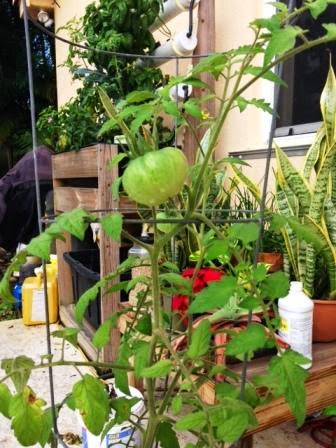
 This is an Indigo Rose growing in an NFT Tube with a little cayenne pepper poking out behind it.  The Indigo Rose seeds were from my son's garden in Ohio.  When I visited in August, I opened one of his ripe tomatoes onto a paper towel and spread out the seeds and flesh to dry.  I brought the dried paper towel home and planted it, towel and all in October.  The Indigo Rose was by far the most prolific producer.  I had them in DWC rafts, flood and drain beds and soil.  They performed well in all situations.  The only down side to this tomato is that it takes for-fricking-ever to ripen.  The portion of the tomato that is kissed by the sun turns a bluish purple, the remainder will turn red or yellow when the tomato is ripe. 
Arkansas traveler tomato in aquaponics
 This was my Arkansas Traveler when it was setting its first fruit.  I only had one plant this year, but will certainly save seeds (using the paper towel method) because this is a great tasting tomato. It doesn't grow extremely large in either plant size or fruit size.  When ripe, it is a pink color.  It is very tasty and low acid.
mr stripey tomato
This is a "Mr. Stripey" that was growing in soil in a pot.  A real down side to buying starter plants is that anyone with a sense of mischief can cause problem in the garden center.  I bought this plant as a start and it was clearly marked "Mr. Stripey", which happens to be one of my favorite tomato varieties.  As it began to set fruit, O started doubting the veracity of the tag.  The tomatoes weren't as large as they should be and didn't exhibit stark striping.  When the first fruits started to ripen I knew I had been had.  The fruits turned red and not the beautiful orange-ish shade sported by Mr. Stripey.  I don't know who this imposter is, but it produces a medium sized red tomato with very light striping.  Unlike Mr. Stripey, it is very low acid. I am not saving the seeds.  I considered prosecuting it for impersonating a beloved heirloom, but decided the real culprit was the person at the garden center, not the plant.

Inedibles in Closing

  Believe it or not, the winter months aren't all about vegetables here at the end of the peninsula.  The shorter days mean that lots of plants start to bloom.  While you are looking at snow, I'm looking at kolanchoes.
 I'm enjoying the orchid blossoms.
And the Bolivian gloxinias start to bloom before Christmas and take us all the way through to Easter.
 
My season was a mixture of hits and misses.  Let me know what you are doing to make your season a success.  I'd love to hear from you!

Monday, June 2, 2014

Aquaponics Doesn't Have to Be Ugly


My hubby has been itching to build a new aquaponic garden.  He has had an IBC tote cluttering up the garage for several weeks.

The problem is that we are running out of space.  We do not have much growable space to begin with.  Some of what we do have is shaded.  The areas that get enough sun for growing edibles are already occupied by aquaponic gardens or conventional soil beds.
Little Okra

He has been eying our swimming pool deck and commenting about the abundance of sun it receives.  Of course it does, who puts a swimming pool in the shade?  I could see where the hints were going.  By the time he said he wanted to put an aquaponic garden by the pool, I had accepted that this was going to happen.  I just wanted to minimize the damage. 

By damage, I mean that our house is built around the pool area.  It is visible from most rooms in the back of the house.  I did not want to look at something ugly.  Let’s face it, most aquaponic gardens are collections of tubs, barrels, buckets and lots of pipes and tubing.  These components are not terribly attractive.  While our existing aquaponic gardens are not eyesores, they are not exactly things of beauty.  Even though they are full of beautiful growing things, I don't want something like that the focal point of the back of my house.

I was willing to compromise (one of the reasons we have been married for over 30 years) and he was willing to compromise (another reason our marriage has lasted so long).  I agreed to the IBC, if he agreed to do some extra work so that it was not an ugly eyesore.

IBC Aquaponic Garden
Voila!  He clad the system in pressure treated lumber so that it will withstand the elements and from the house, it almost looks like a hot tub! The bottom holds 125 gallons and the top gives us a grow area of roughly 4 feet by 4 feet. Plenty of room for the tilapia and veggies!  He fitted it with a bell siphon, but I would like to change it over to a timed flood and drain. I like the way that method performs on the larger systems.

This past week end we began cycling.  Because I can’t stand for the fish to die, we are cycling with ammonia.  You can read my January post about my experiences cycling with and without fish and come to your own conclusions about cycling with fish.

Just to start, I put in some purple hull peas and Cajun Jewel okra.  I already have plenty of okra in our other grow beds and even some in rafts and NFT tubes, so I think we can expect a large crop of okra.  Unfortunately, because it is the rainy season, there is very little we can grow.  Summer in South Florida is like winter in the Midwest or North, there are very few edible plants that can survive.

Which brings me to an RIP moment.  One of the first thunderstorms that came barreling off the Everglades produced a lightening strike that has taken out one of my coconut palm trees.  As you can see in this photo, the tree is dying and you can even see the stripe on the tree trunk where the lightening exited. 
Coconut Tree with Lightening Scar
 It appears that the areca palm next to the coconut is a goner as well.  The areca only went in after hurricane Wilma.  The coconut is over 20 years old.  I  will miss them.  Its like saying good-bye to an old friend.

Areca with burned fronds
Do you get attached to your trees?

Monday, May 19, 2014

Floaters versus Sinkers - Seed Wars

When it comes to planting okra, I always like to soak my seeds for a day before planting.  I am sure there is a highly scientific reason that okra seeds should be soaked, but I do it because my father always told me "Cheryl, soak your okra seeds before you plant them."  He has been dead over 15 years, but I still do what he says.

Soaking this last batch of Cajun Jewel okra seeds, I noticed something strange.  Some of the seeds floated on the top and some sunk to the bottom.  As many times as I have planted okra, I couldn't remember if I had ever seen this before.
Floaters and Sinkers

It is possible this happens every time and I have never paid attention before.  Honestly soaking the seeds is usually one of those "Oh Crap" things you remember just before you go to bed.  You are in your jammies, turning out the lights and locking up the house when you remember that you were planning on starting those okra plants the next day.  So the standard practice is usually to find the seeds, dump them in a glass of water and go to bed without giving it another thought until I am ready to plant them the next day.

This time I remembered so far in advance that I paid attention to what I was doing when I popped the seeds in the glass.  Immediately I noticed floaters and sinkers.

I had a theory about floaters and sinkers.  I decided that the floaters didn't have much to get them started and that they would probably not germinate at all.  I hypothesized the sinkers were better seed and would have a higher germination rate and would grow faster.

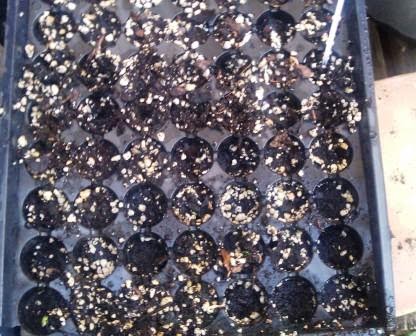
So, the next day I carefully separated the sinkers from the floaters.   The floaters went in one starter flat and the sinkers went in another starter flat.  They were placed in the same area so that they would receive the same amount of water and sun.

I planted them on Thursday afternoon and as you can see that by Sunday morning there was a definite difference in the germination between the floaters and sinkers.  The floaters were sprouting away and the sinkers not so much.
Sinkers on Sunday May 11

I waited until Tuesday to check on them again.  At that point, the floaters and sinkers were the same size!!!!

So, the sinkers germinated quickly, but once germinated didn't grow up any faster than the slower germinating floaters. 
Floaters on Sunday May 11

Unless you are in a really short growing season and you need those extra two days, there is no difference between your floaters and sinkers, except that some float and some sink.

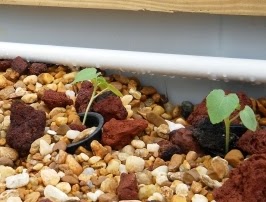
I transplanted both floaters and sinkers into flood and drain grow beds.  I have one bed filled with lava rock and the other filled with hydroton.  I also set a couple of floaters and sinkers in a DWC raft.  I also put one each floater and sinker in soil.

Since transplanted on Saturday, floaters and sinkers in the lava rock have produced their first true leaves.  The floaters and sinkers in the hydroton and the DWC raft have not produced true leaves yet.

As you can see in the photos I took today (Monday), in the lava rock grow bed, there is no difference between a floater and sinker.

Floater and Sinker on May 19


So, don't throw out your floaters. 

Stay tuned for updates during the growing season.