It is very hard to grow anything edible in those conditions (well except that the mangoes and avocados are getting ripe). The irony of all ironies is that I can grow a few things using aquaponic techniques during this time. Yes, plants that would drown from all the rain if they were planted in soil will do OK if they are planted in water. They just must be plants that can take the heat.
Right now in my at home aquaponic gardens, I have purple hull peas, mint, lemon balm, rosemary, vinca, french marigold, oregano, miniature pepper, green onion, and lots of okra growing. The okra are the plants from the Floaters versus Sinkers seed wars I chronicled. As I suspected, there is really no difference between the floater and sinker seeds once the seedlings were planted.
However I am seeing a difference in how the okra is growing using different techniques. Unfortunately I don't have photos of the plants that were growing the best. These were the plants that were in NFT tubes. Even though the okra variety is Cajun Jewel, a dwarf variety, they still get several feet tall. Once I could no longer reach the plants in the tubes, I had to take them out and transplant them. This involved pruning both roots and tops. I re-established them in my newest media grow bed with my purple hull peas and due to the pruning they are now the smallest of the plants. Bonsai okra so to speak.
 The okra in the DWC (deep water culture) rafts are growing steadily. However they have not flowered and produced fruit yet. As you can see, the plants are exceptionally healthy and should be flowering any day now. By the way, the crud on the raft is caterpillar poo. Hubby thought it would be nifty to put some zinnias on the raft, but instead grabbed some of my milkweed seedlings. Needless to say it only took a few days to have monarch eggs and within 10 days they had hatched, eaten every bit of milkweed on the raft, and then conscripted into the caterpillar relocation program (CRP).
 The okra that were planted in media beds filled with hydroton and gravel are also doing well. They have just started to flower. What is odd about this set outperforming the set in the raft is these plants receive an eastern exposure. The plants in the raft get a southern exposure. Southern exposure equals more sun, however the eastern exposure plants are outperforming their southern kin. I know that there are people sold on DWC for all plants, but it has been my experience that in most instances plants in media beds do better. Maybe I am doing something wrong, but I get more nitrates using a media bed than depending on the biofilm on the raft.
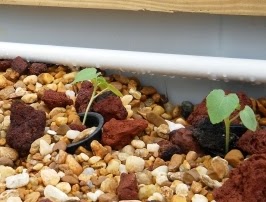
 The current superstar okra (since their kin in the NFT tubes got the bonsai treatment) are the okra that are in a bed of lava rock and a small layer of gravel. I really don't like planting in lava rock because even with gloves on your hands it is hard work and always seems to ruin my manicure. But those lava rocks provide an incredible amount of specific surface area for the nitrifying bacteria to take hold. The honeycomb
 structure is similar to zeolite. These okra plants have already begin to bloom, fruit, and produce their first harvest. The okra have already crowded out the bottom row of NFT tubes that are mounted over the bed. I am planning on using that tube again when the okra get just a bit taller. As I did last year, I will use the okra as a shade for other plants on that bottom tube. This system is getting southern exposure like the DWC system, but it is doing so much better.
I was joking with a fellow gardener on-line this morning that I know so much useless information about okra. It is in the same family as the hibiscus and cotton. If you have ever seen an okra bloom, you know that they are very beautiful flowers. And if you time time to actually look at an okra bud and bloom then you can easily see how hibiscus and okra are related. The buds and flowers are shaped in a very similar manner.

 I know lots of people don't like okra, but I think you just have to give it a chance. It is only slimy if you boil it. People eat oysters and they are slimy! If you have an overabundance of okra, pick it while it is small and make pickles. I like them pickled hot, bread and butter, or dill style. I don't think I have ever made the acquaintance of an okra pickle that I didn't like. I can't say the same for cucumber pickles. Besides what would gumbo be without okra? Okra is the defining ingredient in gumbo. If it isn't thickened with okra, then it is just another soup. And okra makes an excellent fried vegetable.
By the way, I planted some of my okra seedlings in soil on the same day as I placed the others in the aquaponic gardens. I've even given them a little fish emulsion to try to make things even. The growth of the plants in soil can't be compared to even the slowest growth of the plants in the DWC system. The soil based plants are not as richly colored and have not produced a bud or bloom yet. Their leaves are smaller and the plant stems thinner. But they do attract visitors. I wonder if this monarch is related to any of the 'pilars that started out on the DWC raft?

If you have never tried to grow okra, I encourage to give it a shot. It is very forgiving and once it gets going is a prolific producer. Even if you grow in soil, I still recommend growing the dwarf varieties because okra can get tall. And last but not least, be sure to save some of your seed. All of these plants are from last year's seed.
OK, I've shown you my okra......let's see yours!