Showing posts with label flood and drain. Show all posts

Thursday, July 3, 2014

Okra in Aquaponics

It has been awhile since I've posted.  As I've written before, there is not much gardening that goes on in South Florida once the rainy season starts.  Our temperatures are in the 90's almost everyday.  In the month of June we had over 15" of rain and that was before our first brush with tropical weather.  To say that it is hot and humid would be like saying the Atlantic Ocean has a little water in it.

It is very hard to grow anything edible in those conditions (well except that the mangoes and avocados are getting ripe).  The irony of all ironies is that I can grow a few things using aquaponic techniques during this time.  Yes, plants that would drown from all the rain if they were planted in soil will do OK if they are planted in water.  They just must be plants that can take the heat.

Right now in my at home aquaponic gardens, I have purple hull peas, mint, lemon balm, rosemary, vinca, french marigold, oregano, miniature pepper,  green onion, and lots of okra growing.  The okra are the plants from the Floaters versus Sinkers seed wars I chronicled.  As I suspected, there is really no difference between the floater and sinker seeds once the seedlings were planted.

However I am seeing a difference in how the okra is growing using different techniques.  Unfortunately I don't have photos of  the plants that were growing the best.  These were the plants that were in NFT tubes.  Even though the okra variety is Cajun Jewel, a dwarf variety, they still get several feet tall.  Once I could no longer reach the plants in the tubes, I had to take them out and transplant them.  This involved pruning both roots and tops.  I re-established them in my newest  media grow bed with my purple hull peas and due to the pruning they are now the smallest of the plants.  Bonsai okra so to speak.

okra in aquaponicsThe okra in the DWC (deep water culture) rafts are growing steadily.  However they have not flowered and produced fruit yet.  As you can see, the plants are exceptionally healthy and should be flowering any day now.  By the way, the crud on the raft is caterpillar poo.  Hubby thought it would be nifty to put some zinnias on the raft, but instead grabbed some of my milkweed seedlings.  Needless to say it only took a few days to have monarch eggs and within 10 days they had hatched, eaten every bit of milkweed on the raft, and then conscripted into the caterpillar relocation program (CRP).

The okra that were planted in media beds filled with hydroton and gravel are also doing well.  They have just started to flower.  What is odd about this set outperforming the set in the raft is these plants receive an eastern exposure.  The plants in the raft get a southern exposure.  Southern exposure equals more sun, however the eastern exposure plants are outperforming their southern kin.  I know that there are people sold on DWC for all plants, but it has been my experience that in most instances plants in media beds do better.  Maybe I am doing something wrong, but I get more nitrates using a media bed than depending on the biofilm on the raft.

The current superstar okra (since their kin in the NFT tubes got the bonsai treatment) are the okra that are in a bed of lava rock and a small layer of gravel.  I really don't like planting in lava rock because even with gloves on your hands it is hard work and always seems to ruin my manicure.  But those lava rocks provide an incredible amount of specific surface area for the nitrifying bacteria to take hold.  The honeycomb
structure is similar to zeolite.  These okra plants have already begin to bloom, fruit, and produce their first harvest.  The okra have already crowded out the bottom row of NFT tubes that are mounted over the bed. I am planning on using that tube again when the okra get just a bit taller.  As I did last year, I will use the okra as a shade for other plants on that bottom tube.  This system is getting southern exposure like the DWC system, but it is doing so much better.

I was joking with a fellow gardener on-line this morning that I know so much useless information about okra.  It is in the same family as the hibiscus and cotton.  If you have ever seen an okra bloom, you know that they are very beautiful flowers.  And if you time time to actually look at an okra bud and bloom then you can easily see how hibiscus and okra are related.  The buds and flowers are shaped in a very similar manner.
okra in aquaponics bloom
I know lots of people don't like okra, but I think you just have to give it a chance.  It is only slimy if you boil it.  People eat oysters and they are slimy!  If you have an overabundance of okra, pick it while it is small and make pickles.  I like them pickled hot, bread and butter, or dill style.  I don't think I have ever made the acquaintance of an okra pickle that I didn't like.  I can't say the same for cucumber pickles.  Besides what would gumbo be without okra?  Okra is the defining ingredient in gumbo.  If it isn't thickened with okra, then it is just another soup. And okra makes an excellent fried vegetable. 

 By the way, I planted some of my okra seedlings in soil on the same day as I placed the others in the aquaponic gardens.  I've even given them a little fish emulsion to try to make things even.  The growth of the plants in soil can't be compared to even the slowest growth of the plants in the DWC system.  The soil based plants are not as richly colored and have not produced a bud or bloom yet. Their leaves are smaller and the plant stems thinner.  But they do attract visitors.  I wonder if this monarch is related to any of the 'pilars that started out on the DWC raft?  

If you have never tried to grow okra, I encourage to give it a shot. It is very forgiving and once it gets going is a prolific producer.  Even if you grow in soil, I still recommend growing the dwarf varieties because okra can get tall.  And last but not least, be sure to save some of your seed.  All of these plants are from last year's seed.

OK, I've shown you my okra......let's see yours!

Monday, June 2, 2014

Aquaponics Doesn't Have to Be Ugly


My hubby has been itching to build a new aquaponic garden.  He has had an IBC tote cluttering up the garage for several weeks.

The problem is that we are running out of space.  We do not have much growable space to begin with.  Some of what we do have is shaded.  The areas that get enough sun for growing edibles are already occupied by aquaponic gardens or conventional soil beds.
Little Okra

He has been eying our swimming pool deck and commenting about the abundance of sun it receives.  Of course it does, who puts a swimming pool in the shade?  I could see where the hints were going.  By the time he said he wanted to put an aquaponic garden by the pool, I had accepted that this was going to happen.  I just wanted to minimize the damage. 

By damage, I mean that our house is built around the pool area.  It is visible from most rooms in the back of the house.  I did not want to look at something ugly.  Let’s face it, most aquaponic gardens are collections of tubs, barrels, buckets and lots of pipes and tubing.  These components are not terribly attractive.  While our existing aquaponic gardens are not eyesores, they are not exactly things of beauty.  Even though they are full of beautiful growing things, I don't want something like that the focal point of the back of my house.

I was willing to compromise (one of the reasons we have been married for over 30 years) and he was willing to compromise (another reason our marriage has lasted so long).  I agreed to the IBC, if he agreed to do some extra work so that it was not an ugly eyesore.

IBC Aquaponic Garden
Voila!  He clad the system in pressure treated lumber so that it will withstand the elements and from the house, it almost looks like a hot tub! The bottom holds 125 gallons and the top gives us a grow area of roughly 4 feet by 4 feet. Plenty of room for the tilapia and veggies!  He fitted it with a bell siphon, but I would like to change it over to a timed flood and drain. I like the way that method performs on the larger systems.

This past week end we began cycling.  Because I can’t stand for the fish to die, we are cycling with ammonia.  You can read my January post about my experiences cycling with and without fish and come to your own conclusions about cycling with fish.

Just to start, I put in some purple hull peas and Cajun Jewel okra.  I already have plenty of okra in our other grow beds and even some in rafts and NFT tubes, so I think we can expect a large crop of okra.  Unfortunately, because it is the rainy season, there is very little we can grow.  Summer in South Florida is like winter in the Midwest or North, there are very few edible plants that can survive.

Which brings me to an RIP moment.  One of the first thunderstorms that came barreling off the Everglades produced a lightening strike that has taken out one of my coconut palm trees.  As you can see in this photo, the tree is dying and you can even see the stripe on the tree trunk where the lightening exited. 
Coconut Tree with Lightening Scar
 It appears that the areca palm next to the coconut is a goner as well.  The areca only went in after hurricane Wilma.  The coconut is over 20 years old.  I  will miss them.  Its like saying good-bye to an old friend.

Areca with burned fronds
Do you get attached to your trees?

Thursday, March 27, 2014

Worms in Aquaponics?

Last week I was cleaning out one of the beds that uses a continuous flow technique.  The plants had become so overgrown that it was time to do some serious pruning.  Because I was removing so much of the top of the plants I thought it would be a good idea to prune the roots as well.  These Everglades tomato plants are so hardy and they really respond to this pruning technique.

The grow media in this particular bed was a base of pea sized gravel with about 2 inches of expanded clay (Hydroton) on the top.

When the bed was first set up, I put some earthworms in there just to see how they did.  The answer to that question is..... they did wonderful thank you very much!  The earthworms help break down solids from the fish tank and help keep your grow beds clean.  They also assist with "mineralization" which is a fancy term that means they convert their food to available nutrients for the plant roots.  If you read much about serious aquaponics then you will run across the use of worms, but not earthworms.

My earthworms didn't know that they were not the preferred worm for aquaponics.  Each time I dug up some roots to prune I came up with enormous earthworms!  Now I know many aquaponic enthusiasts are crazy for red wigglers for their worms, but I am liking earthworms.  The first and foremost reason is because earthworms are cheap.  They are already growing in our compost beds.  We don't have hardly any red wigglers in our compost.  Maybe they aren't indigenous to South Florida.  I don't know, I just know that if you want red wigglers you have to buy them.

Because our compost pile is fed with bunny manure, I purge the worms before putting them in the bed.  I don't want to introduce any e.coli from our furred friends into the aquaponic gardens. 

Purging the worms is easy, just put them in a small amount of moistened corn meal for a few hours and they will have the equivalent of terrible diarrhea and vomiting. It is gross when you look in and see all that black gunk in the cornmeal, but the worm is clean inside and out.

I just give them a quick rinse in some water from one of the fish tanks and then into the bed they go and boy do they grow!

I put just a few earthworms in there when I set up the bed with the tomatoes at the end of last summer and now it is full of earthworms.  I have been routinely adding worms to each new bed that we set up, but I haven't done much in the way of digging around to see how they were doing.  Out of sight out of mind is the way they have been operating.

So I say if you don't have some worms in your grow beds, get some.  You may not have to go any further than your compost pile.

So do you use worms in your aquaponics beds?

Thursday, January 30, 2014

Super Greens are Super Food


Super greens and power greens.  They are all the rage with foodies and nutritionists alike right now.  Everyone is crazy for kale.  I like kale as much as the next person (I even have loads of it started right now) and I have high hopes that kale can be my next chard.

By "next chard" I mean a plant that sprouts easily, thrives in the aquaponic environment, and produces an abundance of edibles.  Since the fall, we have been enjoying an abundance of chards.  We have the traditional Fordhook chard as well as the Bright Lights colored Swiss chard.  As usual, the seed from Southern Exposure had a germination rate of almost 100%.

I admit to sprouting the chard seeds in soil and a wicking bed I rigged up, but once they hit the auqaponic systems they took off.
Chard in NFT Tubes on A-Frame

Bright Lights Chard in DWC raft

Chard in expanded clay media bed, flood and drain
While they seem to have done best in the NFT tubes, they performed well using all techniques.

I have been harvesting with a "cut and come again" strategy.  This means I don't harvest the entire plant at once.  I harvest the lower leaves and the plant continues to grow from the top.  This explains the odd growth pattern you may see in the pictures. The stem may start growing a little crazy, but the plant continues to produce new leaves and that means more for us to eat.

It means so much to eat that I have been stretching my culinary capabilities to find new uses for chard.  Chard pizza anyone?  It was actually quite tasty.  I wilted the red chard before baking it on the pizza.  Chard frittata?  It made a yummy brunch.  Of course sauted chard, boiled chard, chard wilted with bacon, chard and cornbread. Chard has made its way into just about everything but the Cheerios.  But if they keep going this strong, the Cheerios might be next.

Seriously, if you are going to the trouble to grow your own food, why not make it something that will pack a nutritional punch.  Chard has at least 13 flavonoids. One of the primary flavonoids found in chard is syringic acid. Syringic acid has recently received special attention due to its blood sugar regulating properties. It has been shown to inhibit activity of an enzyme called alpha-glucosidase. When this enzyme gets inhibited, fewer carbohydrates are broken down into simple sugars and blood sugar stays steadier.  This is important to anyone that is concerned about diabetes, weight control, or eating low on the glycemic index.

Chard also is rich in betalains, just like its cousin the beet.  This phytonutrient has antiinflamatory, antioxident and detoxification properties.  Chard as a beauty product?  Sure, if we are what we eat, why not eat something rich in vitamins A and K so that healthy skin starts from the inside. Chard packs a punch of vitamin C as well.  If you are fearful of the oxalic acid found in chard, be aware that it is concentrated in the stems.  So, all you have to do is add the stems first (so they will cook longer than the leaves) as heat destroys the oxalic acid or if you are eating the chard raw, just discard the stems. 

Got any good chard recipes?  What is the super survivor in your garden right now?

Wednesday, January 8, 2014

A Tale of Two Eggplants

I love nightshades.  They are one of the most diverse families of plants and contain some of my most favorite things to eat.  The Solanaceaes include tomatoes, peppers, eggplants and potatoes.  It also includes petunias and tobacco..  You can keep the potatoes, petunias and  tobacco.  I don't smoke, I don't like to eat potatoes ( I prefer rice) and petunias stink. But tomatoes, peppers and eggplants....Oh My!  And cooking all three together?  Even more Oh My!

I am currently growing several types of tomatoes, peppers, and one type of eggplant.  I have had poor luck with germinating pepper and eggplant seeds this season for some reason.  I put my eggplants in two different test systems this time to see if there was a difference in plant growth or production.  Early results say that my eggplants are preferring a flood and drain environment to a deep water culture (DWC) system.

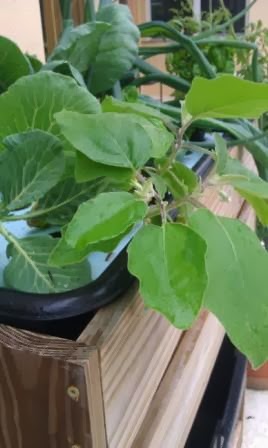
Here is the picture of the eggplant in my flood and drain test bed. 
The largest leaf on this plant measures 9" wide and is 11" long. As a matter of fact I had to tie it up today as the leaves are so heavy the plant had flopped over and was shading the rosemary.

Here is a picture from the deep water culture test bed.
The largest leaf on this plant measures 4" wide and 4" long. It has just flowered.  Same type of plant, planted at the same time.  By the way, look in the background of this picture and you can see how much my onions love DWC. If you don't have onions in your DWC get some now!

The flood and drain system is only slightly older than the DWC by about 2 weeks.  Both systems were cycled early last spring so they are approaching their first birthday.  Both have the same number of fish.

So far, it is looking like flood and drain is the way to go for growing eggplant.  Part of making sure your garden can survive is testing things out to see what works best.  Before growing anything on a larger scale, I run a test garden. I am also currently testing peppers in flood and drain versus nutrient film technique (NFT).
Stay tuned for those results.

How do you grow your eggplants?

Monday, August 19, 2013

Aquaponics vs Soil - Growing Okra

If you have ever grown okra in soil, you know there is a very small window in which to harvest your okra.  One day's growth can make all the difference between okra that is edible and okra that is so tough and woody you can barely cut it with a knife.

This summer, I have been testing okra in both soil and aquaponics.  I started all tests using Cajun Jewel variety of okra.  This is an heirloom variety and I used organic seed.  I soaked all seeds overnight before planting.  I have to admit, this was great seed from the Southern Exposure Seed Exchange.  The germination rate was almost 100%, with only a couple of seeds not sprouting.

The only fertilizer I used on the soil-based plants was a bit of organic bone meal scratched into the soil as a side dressing two weeks after the plants germinated.  For the aquaponics plants,  I used both flood and drain and deep water raft techniques.  The soil grown plants did begin to produce much faster than the aquaponics plants by almost 10 days. I didn't see much difference in production between the soil plants and the aquaponics plants. All plants produced profusely all summer long.  But I did see one major difference that makes aquaponics the hands down winner.

When grown with aquaponics, the okra was still tender even when it was well over 3 inches long.  The soil based plants produced pods that were quickly tough when they exceeded 1 1/2 inches.  This is important if your schedule doesn't allow you to get out and harvest every single day.  Also, if you are planting for survival, you can't afford to let a single pod go to waste (or the compost). 

As you can see, in this flood and drain set up, the leaves are huge and the pods have been tender, regardless of how large they were allowed to grow. 

Another benefit of the large okra leaves is that they provided shade for my lettuce.  By placing my lettuce in the lower NFT tube, the okra provided needed shade.  I am in South Florida, and our August sun is harsh.  The okra allowed me to continue to grow lettuce with aquaponics when it would not be possible with soil.  This is another survival technique that I recommend.  Layer your garden to take advantage of  what nature provides. It will extend your growing season.

You might notice that I used marigolds on the upper NFT tube as a companion plant.  The only problem I had with pests was a brief encounter with aphids.  I have never been a fan of marigolds, but I am sold on their effectiveness in repelling other pests (especially squash bugs).

So have you tested plants in soil versus aquaponics? I would love to hear your results.